

User Location Map for a Startup's Admin · Web Development
Konnect
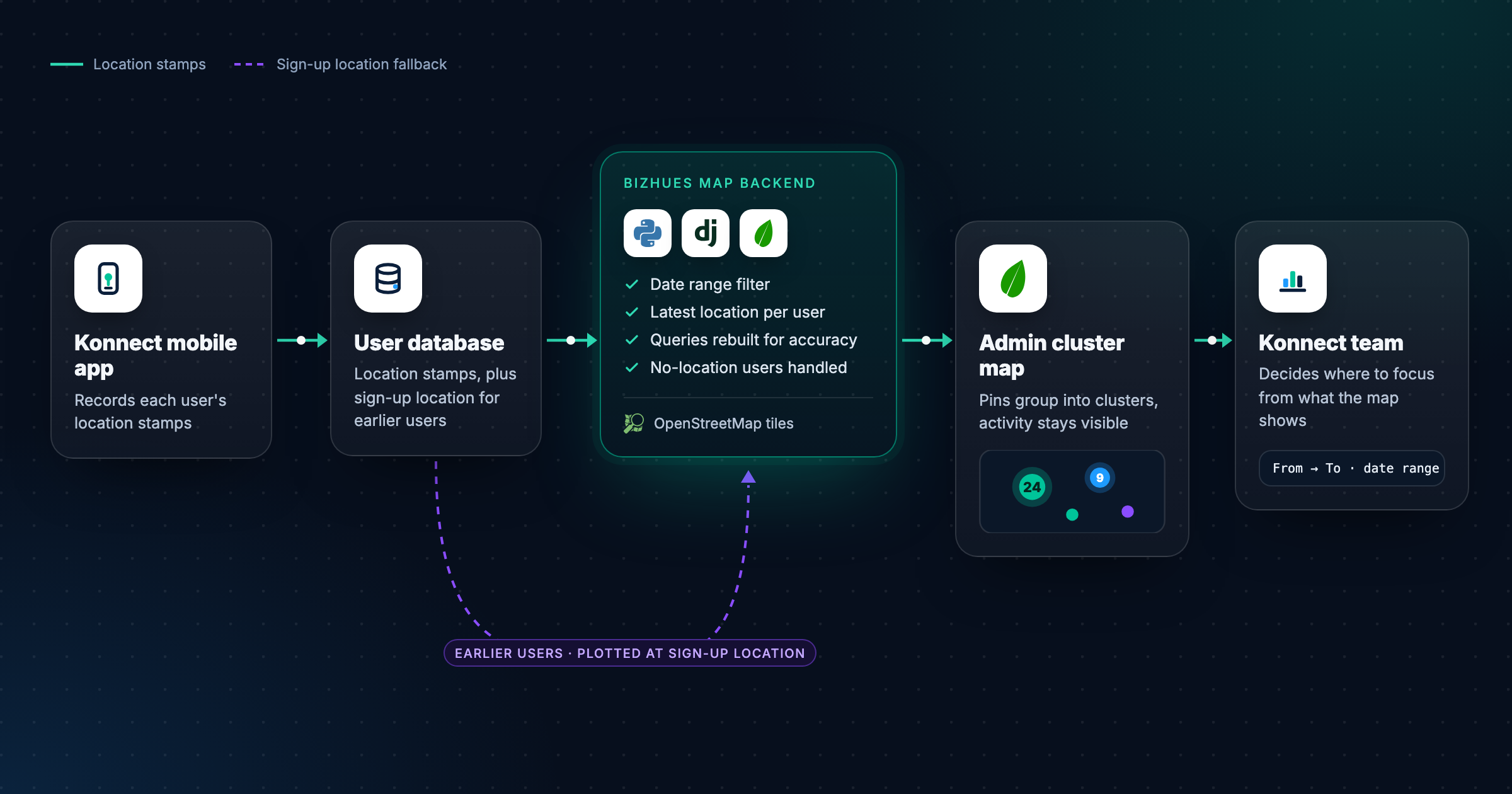
Konnect is a location-based startup in the United States. Its team decides where to focus by looking at where its users are, so the map in its admin backend has to be right. We rebuilt that map as a fast, accurate cluster map with date filtering, on top of reworked data queries.
Built with
- Python
- Django
- Leaflet
- Leaflet.markercluster
- OpenStreetMap
- GitLab
Expertise
- Map and geolocation features
- Admin dashboards
- Query design for accurate reporting
- Technology selection
- Code review
Verticals
- Location-based apps
- Startups
- Mobile apps
Konnect's mobile app records location stamps for its users, and the team reads them on a map in the admin backend. That map was the basis for business decisions, but it was not showing what the team needed, and they did not fully trust it.
They wanted a cluster map that could be filtered by a date range, showing each active user once at their latest location in that range. Users who had joined before location stamps existed still needed to appear, using the location captured at sign-up. The existing legend and pin details had to stay, activity had to remain readable once pins merged into clusters, and users with no location at all had to be accounted for rather than silently dropped.
Before quoting, we asked how the system actually worked: which Python framework, which map library, how often the app reports location and how quickly it reaches the map. We then compared Google Maps Platform and Leaflet for Konnect's case, covering accuracy, ongoing cost under Google's billing model and how far each could be extended, so the team chose with the trade-offs in front of them. They chose a Leaflet cluster map.
Getting access to the code surfaced a problem early: the repository first shared with us was a Flask project last updated in 2018, not the Django app running in production. Flagging it straight away meant the work went into the right codebase.
We built the map into the Django admin: a date-range picker at the top, clustered pins that keep user activity visible, the existing legend and pin details, and the latest location for each user within the selected period, with earlier users plotted from their sign-up location. We added a few extra on-screen elements along the way to make the map easier to read.
Accuracy depended on the data more than the map. When we connected to the live database, its structure did not support the questions the map was asking, so we rewrote almost all of the queries behind it. We also explained why OpenStreetMap shows place names in each country's local language, and set out a free-tier option for English labels.
The map was ready for review ahead of its due date, and the full feature, including a second round to align the backend user data with the map, was delivered in about two weeks, through merge requests in Konnect's GitLab.
Konnect's team now filters its user base by any date range and sees each user exactly once, at the right location, with clusters that still show activity. The numbers they base decisions on come from queries rebuilt for that purpose.
Client feedback
What the client said
Vipin was great to work with. I told him what our requirements were for a map on the backend. He advised on the best route to take, and told me exactly how long he would need to deliver. He completed the task on time, and exactly as we wanted. Plus he gave amazing ideas along the way and his eye for design exceeded our expectations. Can’t recommend him enough. Will definitely be collaborating with him in the future.
Talk to an engineer
Like what you see?
Tell us about the system you need. We reply with questions and a suggested first step.